
For Texas RLA teachers, grades 3–8 and English I and II
Grade STAAR extended constructed responses the way the state does
Import essays from Canvas or upload them, and AutoMark scores each one on the TEA rubric for your grade and writes feedback on every paper. You review and approve every score before a student sees it.
FERPA-aligned · Student work never trains AI · DPA on request
How it works
How STAAR ECR grading works in AutoMark
- 1
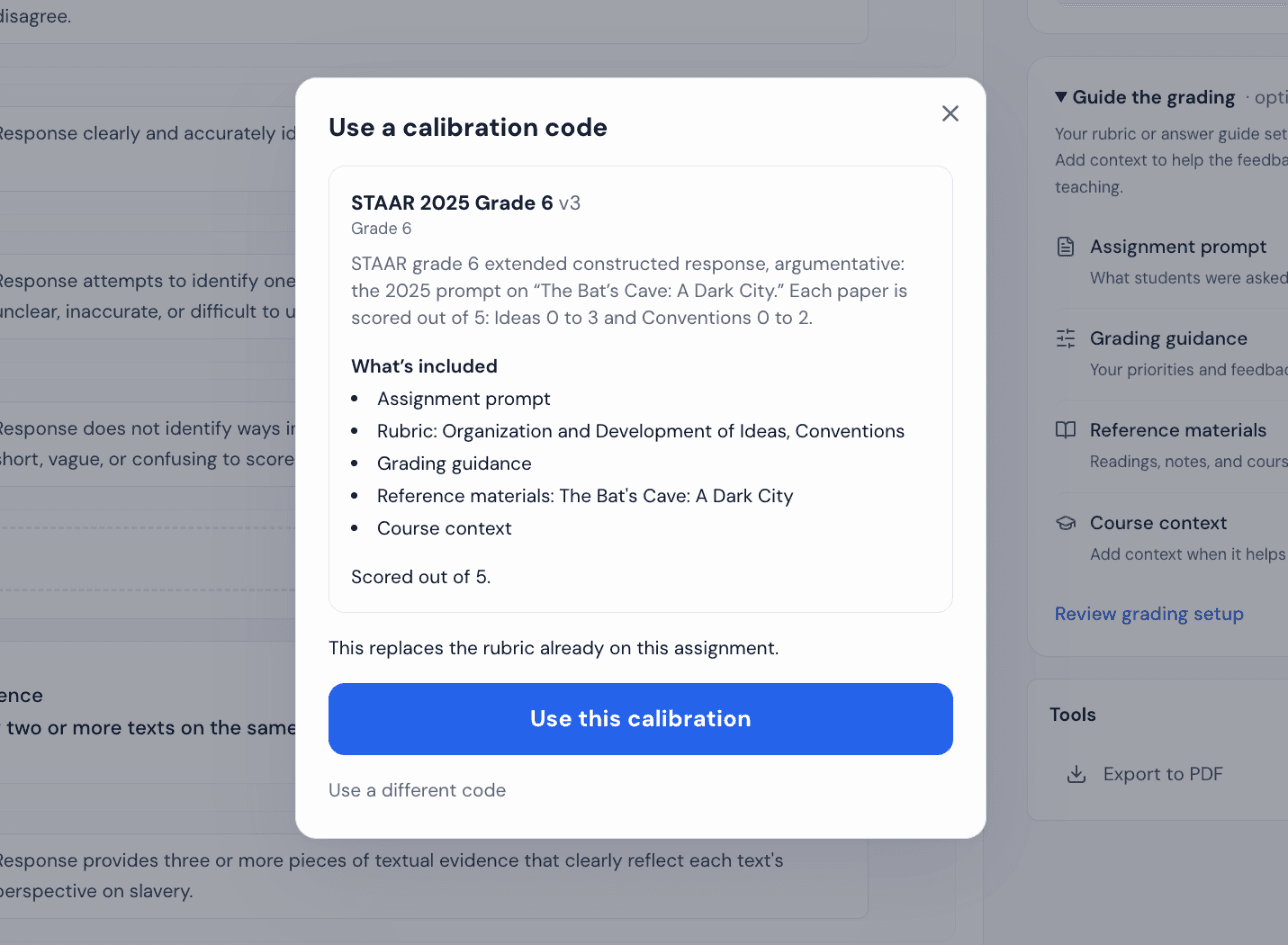
Enter the code for your grade
Sign up free, open an assignment, and choose "Use a calibration code". The code sets the TEA rubric, the grading guidance and the scoring for your grade. You see what it sets up before anything changes.
- 2
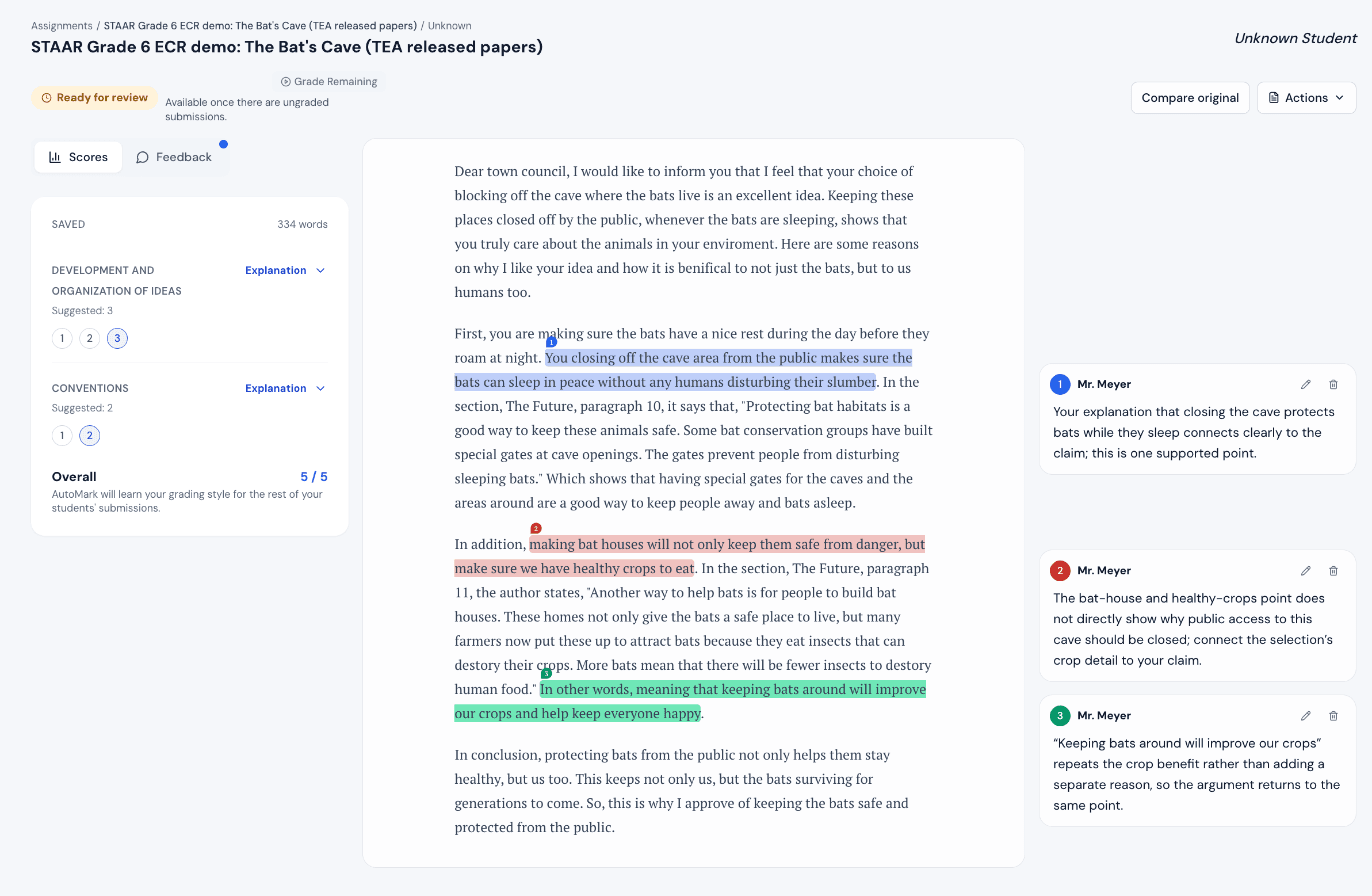
AutoMark scores every paper on the rubric
Import the class from Canvas or upload the papers, typed or scanned. Each one gets an Ideas score, a Conventions score, and comments tied to the lines they are about. You read each paper with the scores beside it, change anything you disagree with, and approve it.
- 3
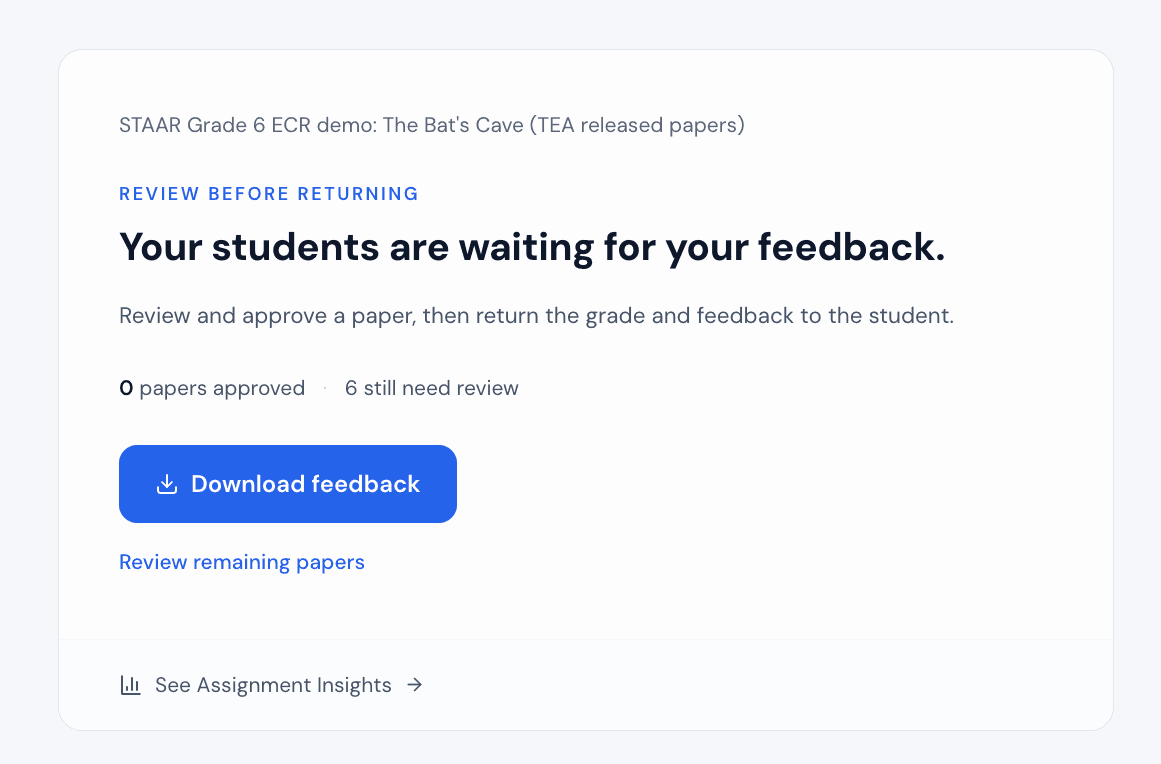
Return approved scores to Canvas
Nothing goes back until you have approved it. When the class is reviewed, send the scores and feedback to the Canvas gradebook in one step, or download the graded papers and feedback if you are not on Canvas.
The rubric, explained
How is the STAAR ECR scored?
TEA scores every extended constructed response on two traits. Development and Organization of Ideas is worth 0 to 3 points and Conventions is worth 0 to 2, for a total of 0 to 5 from one reader. Two readers score each essay, and their totals are added for the 0 to 10 score on the report. Here is what each score point means.
Development and Organization of Ideas (0–3)
Four things are judged at every level: the claim, the organization, the evidence, and how clearly the ideas are expressed.
- 3 points
Clear and fully developed
The writer states a clear claim (or central idea) and develops it all the way through. The essay is organized so a reader can follow it, with an introduction and a conclusion that do real work. Evidence from the reading is specific, well chosen and relevant, and the writer explains how each piece supports the claim. Ideas are expressed clearly. From grade 8 up, an argumentative essay at this level also deals with a counterargument.
- 2 points
Present and partly developed
There is a claim, but it is only partly developed. The organization is limited: the introduction and conclusion may be there, but the essay does not progress smoothly. Evidence is limited, may include details that do not matter, and often is not explained. Ideas are expressed in a basic way, with general or repeated wording.
- 1 points
Evident but not developed
A claim can be found, but it is not developed. The organization is minimal or weak. Evidence is insufficient or mostly irrelevant, with little taken from the reading. The expression of ideas is ineffective, so the reader has to work to follow the point.
- 0 points
No workable claim
A claim may be hinted at, but the essay lacks an introduction and a conclusion, provides no evidence or only irrelevant evidence, and is unclear or incoherent. A 0 also goes to a response that only restates the prompt, only summarizes the reading, is off topic, is mostly copied from the passage, or is blank or only a few words long.
Conventions (0–2)
Sentence construction, punctuation, capitalization, grammar and spelling, judged against what is expected at the student's grade.
- 2 points
Consistent command
The writer shows consistent command of grade-level conventions. There may be a few errors, but they do not get in the way of understanding the writing.
- 1 points
Inconsistent command
There are several errors in sentence construction, punctuation, capitalization, grammar or spelling, but the reader can still understand what the writer means.
- 0 points
Little or no command
There are many errors, and they make the writing hard to understand. A paper that scores 0 on Ideas automatically scores 0 on Conventions, because that rule is printed on the rubric.
Two readers, one score out of 10
One reader gives Ideas 0 to 3 and Conventions 0 to 2, for a total of 0 to 5. Two readers score every essay independently, and their totals are added. That is why the score a school sees runs from 0 to 10, and why Ideas is reported on a 0 to 6 scale and Conventions on a 0 to 4 scale. Readers one point apart are simply added together, which is where odd totals come from. Readers further apart send the paper to an expert reader, whose score is doubled.
Automated scoring and human readers
Since late 2023 every English-language ECR is first scored by an automated engine that TEA trained on past human scores for that prompt. At least a quarter of responses also go to human readers, and for those the human score counts. Readers are trained and qualified on anchor papers chosen for each test.
What changes from grade to grade
TEA publishes a rubric for grades 3 to 5 and another for grades 6 through English II, each in an informational and an argumentative/opinion version. The traits and the points are the same in all four. The differences are small: the younger rubric says "central idea" where the older one says "controlling idea/thesis" or "argument"; a counterargument is expected only from grade 8 up on argumentative prompts; and with paired passages, grades 6 and up need evidence from both texts for a 3, while grades 3 to 5 can earn a 3 from one. What actually sets the standard for each grade is the set of scored sample papers TEA releases every year, not the rubric wording.
Length is not the score
In the released 2025 grade 6 papers, a single 175-word paragraph with paraphrased evidence scored 3 on Ideas and 2 on Conventions. A 500-word five-paragraph essay with cited quotations scored 3 and 1. A 325-word essay that repeated itself scored 2 and 0. The readers scored what the evidence did for the claim, not how much was written.
What scores a zero
The state gives zeros often. In the released explanations and in the rules the automated engine applies, a 0 on Ideas goes to a response where:
- The response only restates the prompt.
- The response only summarizes the reading, with no claim of its own.
- The response does not address the prompt.
- Most of the response is copied from the passage, the prompt or the directions.
- The response is blank, a refusal, mostly in another language, or fewer than about nine words.
And a 0 on Ideas always means a 0 on Conventions.
Grade coverage
STAAR writing rubric by grade: 3 through English II
Each course has its own calibrated setup. The rubric is the one printed in that course’s 2025 released scoring guide, the grading guidance was written from TEA’s explanations of the scored sample papers, and the setup was tested on released papers from other years before it was published. If your own prompt uses the other rubric type for that grade, the traits and the points are the same; a few lines of wording differ.
Grade 3
2025 released prompt: informational
Calibrated setup
Grade 4
2025 released prompt: argumentative / opinion
Calibrated setup
Grade 5
2025 released prompt: informational
Calibrated setup
Grade 6
2025 released prompt: argumentative / opinion
Calibrated setup
Grade 7
2025 released prompt: informational
Calibrated setup
Grade 8
2025 released prompt: informational
Calibrated setup
English I
2025 released prompt: informational
Calibrated setup
English II
2025 released prompt: informational
Calibrated setup
Accuracy
How accurate is it?
Every setup is calibrated to TEA’s released STAAR scoring guides. It scores within one point of the state’s score about 9 times in 10 on state-released papers, and scores run slightly conservative by design, so when you disagree with a score it is more often one to raise than one to lower. You review and approve every score.
What the feedback catches
Common ECR problems, and what AutoMark checks for
These are the problems that cost the most points on released papers. AutoMark checks for each of them on every paper before it scores, so the score follows from what is on the page, and the feedback is written against the same rubric.
The claim is missing
The student summarizes the reading or restates the prompt instead of taking a position. The state scores this 0 on Ideas, however long the essay is.
Evidence is quoted but not explained
A quotation is dropped in and the writer moves on, or the sentence after it just repeats the quotation in other words. Evidence that is not explained caps the Ideas score at 2.
Reasons come from the writer, not the text
The student gives their own opinions as support with nothing from the reading behind them. The rubric asks for text-based evidence.
No conclusion, or no introduction
The essay stops after the last piece of evidence, or starts in the middle of the argument. The organization part of the Ideas score depends on both.
The same point, three times
One reason returns in each paragraph in slightly different words. Readers score it as one reason, and the repetition pulls the Ideas score down.
Run-on sentences and comma splices
Sentences fused with "and" or with no punctuation at all. When they make the writing hard to follow, Conventions drops to 1 or 0.
Spelling, capitalization and grammar
A few slips keep Conventions at 2. Many of them, or errors that change the meaning, do not.
Off topic or copied from the passage
A response that answers a different question, or that is mostly the passage retyped, scores 0 on both traits.
FAQ
STAAR ECR questions teachers ask
Is this the same as the state’s automated scoring?
No. TEA’s engine is a statistical model trained on past human scores for each prompt, and AutoMark has no access to it. AutoMark is a different system, calibrated to the same released scoring guides, and it scores the way the rubric and the state’s explanations of the sample papers describe. You review and approve every score it gives.
Can I change a score?
Yes. Every score and every comment is a draft until you approve it. Change the score, edit or remove a comment, or write your own, then approve the paper. Nothing reaches a student or a gradebook until you do.
How is the STAAR ECR scored, in one sentence?
Each reader gives Development and Organization of Ideas 0 to 3 and Conventions 0 to 2, two readers’ totals are added, and the essay gets 0 to 10. A 0 on Ideas forces a 0 on Conventions.
Does it work with Canvas, Google Classroom or Schoology?
Canvas: yes, when your school has installed AutoMark. Teachers open AutoMark from the Canvas course, import submissions, and send approved scores and feedback back to the gradebook. Google Classroom: any teacher can import student work from it, but grades are not written back. Brightspace and Blackboard are installed by a school. Schoology is not supported. With no LMS, upload files and download the graded papers.
Is student data used to train AI?
No. Student work is never used to train AI. It is encrypted in transit & at rest, handled in line with FERPA, and a data processing agreement (DPA) is available on request.
What about the 2027–28 changes under HB 8?
House Bill 8 replaces STAAR from the 2027–28 school year with shorter tests at the beginning, middle and end of the year. The end-of-year test is still written by TEA, and the writing task stays on it. The beginning- and middle-of-year tests have no writing, so until the end-of-year test the only signal on a student’s writing is the writing they do in class.
Which grades and rubrics are covered?
Grades 3, 4, 5, 6, 7, 8, English I and English II, each with its own calibrated setup. TEA’s informational and argumentative/opinion rubrics share the same two traits and the same points, so the setup for your grade applies to either kind of prompt.
What does it cost for one teacher?
It is free for 30 credits, with no credit card, and one credit grades one paper. After that, Pro is $15 a month or $120 a year for 150 credits a month. Schools can set up every teacher at once.
Can students handwrite their responses?
Yes. Upload PDF, Word (.docx or .doc), plain text, and PNG or JPG images. Scanned and photographed handwriting is read before it is scored, and you see the original beside the transcript.
Do I need to add the reading selection?
For the released 2025 prompt, the selection is included in the setup. For your own prompt, add the passage as a reference material so evidence can be checked against the text, and students’ paraphrases count the way the state counts them.
Get the STAAR calibration for your grade
Sign up free, open an assignment, and choose "Use a calibration code". The code for each grade is posted here as soon as the public setups are published.
The free account includes enough credits to grade a class set. You approve every score before it goes anywhere.
Running this across a campus or district?
Every teacher gets the same calibrated setup, and the campus sees how its writing is scoring before the test does. Talk to us about a pilot for one department or a whole district.